Pelé football legend was seventeen years old. World Cup Final. 100,000 people watching.
Pelé, a football legend, scored twice and won Brazil’s first World Cup.
That boy was Pelé. And from that day in 1958, football was never the same again. Pelé football legend is not something people debate — it is something the entire sport agrees on.

| Detail | Info |
|---|---|
| Full Name | Edson Arantes do Nascimento |
| Known As | Pelé |
| Nickname | O Rei (The King) |
| Born | 23 October 1940, Três Corações, Brazil |
| Died | 29 December 2022, aged 82 |
| Club | Santos FC (1956–1974) |
| Other Club | New York Cosmos (1975–1977) |
| National Team | Brazil |
| Official Club Goals | 643 for Santos FC |
| Brazil Goals | 77 in 92 matches |
| World Cups Won | 3 — 1958, 1962, 1970 |
| World Cup Goals | 12 in 14 matches |
Who Was Pelé?

Pelé was a Brazilian forward who played from 1956 to 1977.
He was not just a goal-scorer. He could dribble, pass, head the ball, and create chances — all while scoring at a rate that made defenders feel hopeless.
FIFA officially named him Player of the Century alongside Diego Maradona in 2000. He did not need the award. The world had already decided long before.
Pelé’s Early Life and Rise to Football Stardom

Pelé grew up poor in Bauru, São Paulo. His father was a footballer whose career ended early through injury.
As a child, Pelé shined shoes to earn money. He could not afford a football, so he played with a sock stuffed with newspaper instead.
None of that stopped him. At fifteen, Santos FC signed him. He scored on his debut. From that day, Santos knew exactly what they had found.
Pelé’s Career at Santos FC

Pelé spent eighteen years at Santos and scored 643 goals in 659 appearances — still the club’s all-time record.
Under Pelé, Santos won six Brazilian national championships, ten São Paulo state titles, two Copa Libertadores (1962, 1963), and two Intercontinental Cups (1962, 1963).
They beat Benfica and then AC Milan in those two world finals. Santos were not just Brazil’s best. They were the world’s best.
In 1975, Pelé joined the New York Cosmos in the United States, helping popularise football in North America before retiring in October 1977.
Pelé’s International Career With Brazil

Seventy-seven goals in 92 matches for Brazil. Three World Cup titles. No other player in men’s football history has ever done that.
Pelé at the 1958 World Cup
Pelé was 17 years old. He scored six goals — a hat-trick in the semi-final and two in the final against Sweden.
Brazil won 5-2. Pelé cried on the pitch. The world watched a teenager win the greatest prize in football.
He remains the youngest player in history to score in a World Cup Final.
Pelé at the 1962 World Cup
Brazil won the 1962 World Cup in Chile — but Pelé missed most of it through a groin injury suffered in the group stage.
His teammates won the title without him. He collected a winner’s medal. Brazil became back-to-back world champions.
Pelé at the 1966 World Cup
England 1966 was painful. Brazil were eliminated in the group stage.
Pelé was repeatedly targeted by rough challenges that referees failed to protect him from. He left the tournament injured and publicly said he would never play in another World Cup.
He changed his mind.
Pelé at the 1970 World Cup
Mexico 1970 is widely considered the greatest World Cup ever — and Pelé was at the heart of it.
He scored four goals and helped Brazil win all seven of their matches. The football they played was beautiful in a way that is still discussed today.
Brazil were given the Jules Rimet Trophy permanently, having won it three times. Pelé scored in the final against Italy and retired from international football undefeated in a World Cup Final.
Pelé’s Playing Style and Greatest Strengths
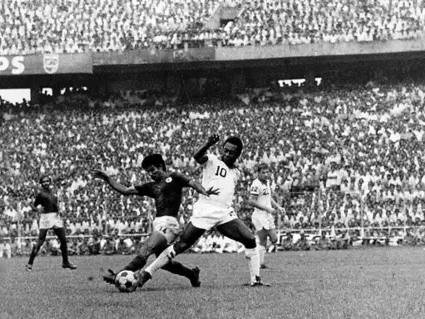
Exceptional Finishing Ability
Pelé scored with both feet equally well. Right foot, left foot — defenders could never commit to covering one side.
His finishing was powerful from distance and precise in tight spaces. He scored every type of goal, in every situation.
Dribbling, Speed and Ball Control
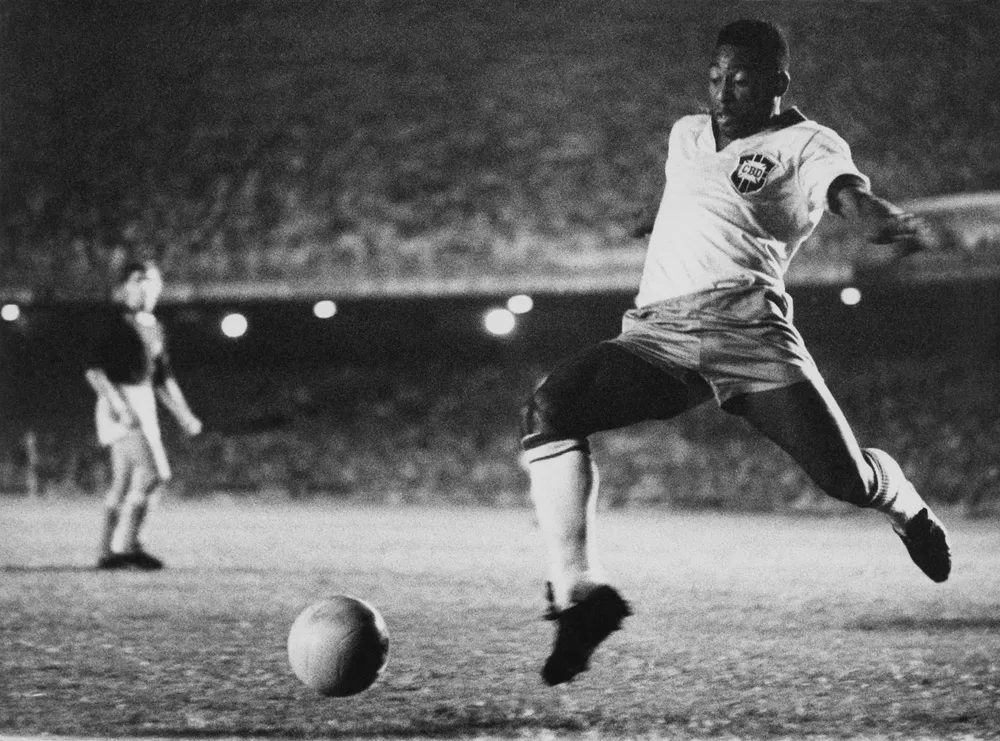
He combined close control with a sudden change of pace that completely unsettled defenders.
In small spaces, he was almost impossible to stop. Once he had space, he was impossible to catch.
Heading and Aerial Ability
Pelé was not exceptionally tall — but his timing and jumping ability made him a constant aerial threat.
Defenders consistently underestimated him in the air. They usually paid for it.
Creativity and Playmaking
He was not purely a goal-scorer. He created chances, played quick combinations, and always understood where his teammates needed the ball.
Santos’ best football happened because Pelé made everyone around him better — not just because he scored.
Intelligence and Positional Awareness
His football brain was as important as his physical ability.
He read space, timed his runs perfectly, and arrived in the right position before defenders realised the danger. In the biggest matches of his career, this quality was most visible.
Pelé’s Career Goals and Major Records
| Record | Detail |
|---|---|
| Santos FC all-time top scorer | 643 goals in 659 appearances |
| Brazil international goals | 77 in 92 matches |
| World Cup goals | 12 in 14 matches |
| Youngest World Cup Final goalscorer | 17 years old — 1958, record still stands |
| World Cups won | 3 — only player in history to achieve this |
| Intercontinental Cup top scorer | 7 goals in 3 matches |
| Guinness World Records | ~1,279 goals in 1,363 matches (includes non-official games) |
Official competitive goals for Santos (643) and Brazil (77) are the most reliably verified figures. Broader totals vary depending on whether exhibition matches are included.
Pelé’s Major Trophies and Individual Achievements
Club Honours — Santos FC
| Trophy | Times Won |
|---|---|
| Campeonato Paulista | 10 |
| Campeonato Brasileiro | 6 |
| Copa Libertadores | 2 (1962, 1963) |
| Intercontinental Cup | 2 (1962, 1963) |
International Honours — Brazil
| Trophy | Year(s) |
|---|---|
| FIFA World Cup | 1958, 1962, 1970 |
Individual Awards
| Award | Detail |
|---|---|
| FIFA Player of the Century | Named jointly with Maradona, 2000 |
| World Cup Golden Boot | 1970 |
| Guinness World Records | Most career goals in football history |
What Made Pelé Different From Other Strikers?

Most elite strikers are brilliant at one or two things.
Müller was the purest finisher. Van Basten had the most perfect technique. Ronaldo Nazário had the most natural explosive ability.
Pelé had all of it — at the same time. Two-footed shooting. Heading. Dribbling. Creating. Performing in finals. Across eighteen years. Without a significant drop in quality.
He was also the first footballer to become a genuinely global celebrity. Before Pelé, football had great players. After Pelé, it had superstars.
Pelé football legend Influence on Modern Football

When Pelé joined the New York Cosmos in 1975, the North American Soccer League averaged around 7,000 fans per game.
Within a year, those numbers had tripled in multiple venues. He made football real in a country where the sport barely existed.
Beyond America, the jogo bonito — the beautiful game — that Brazil became famous for is partly his creation. The idea that football can be both beautiful and winning at the same time.
Every modern forward who uses both feet, who links play as well as finishes, who performs in finals — they all carry part of the blueprint Pelé built.
Pelé vs Other Football Legends
Pelé vs Diego Maradona
Maradona was more explosive, more audacious, and arguably produced more single defining moments — the 1986 World Cup being the clearest example.
Pelé won three World Cups to Maradona’s one and maintained elite consistency for longer.
FIFA gave them the same award. The debate continues. Both answers are completely defensible.
Pelé vs Lionel Messi
Messi won the 2022 World Cup, multiple Ballons d’Or, and built the most impressive club record in modern football.
Pelé won three World Cups and led Santos to back-to-back world club titles.
Different eras make direct comparison difficult. Among those who have watched both, the conversation is genuinely close.
Pelé vs Cristiano Ronaldo
Ronaldo holds the record for most career goals and most international goals. His individual records are historically unprecedented.
Pelé’s three World Cup titles represent a team achievement Ronaldo never reached.
One owns the records. The other owns the trophies that matter most in football.
Pelé vs Ronaldo Nazário
Ronaldo Nazário at his peak — fully fit — may have been the single greatest striker peak ever seen.
But injuries reduced his career significantly. Pelé maintained elite performance for nearly two decades without comparable disruption.
Peak versus longevity. Ronaldo may have the edge in natural talent. Pelé has the edge in everything else.
Was Pelé the Greatest Striker of All Time?

Yes. The clearest reason is simple: nobody else in men’s football history has won three World Cups as a player.
That achievement sits alone. It belongs permanently to one man.
Beyond the trophies, Pelé football legend status rests on a combination the sport has never seen replicated — two-footed finishing, creative intelligence, aerial threat, and the ability to perform at his absolute best in the most important matches of his career. Three times over.
The debate about the greatest ever always starts with Pelé. For most football historians, it ends there too.
Pelé’s Legacy: Why the King of Football Is Still Remembered

Pelé died on 29 December 2022, aged 82.
The tributes came from every country, every sport, and every generation. Current players posted images. Former presidents made statements. Entire nations paused.
He was the first athlete from the developing world to become a true global icon. He showed Brazil to the world through football. Proved that a boy from poverty, playing with a sock stuffed with newspaper, could become the greatest to ever do it.
The Pelé football legend story is not just about goals. It is about what happens when rare talent meets complete dedication — and what that combination can produce for an entire sport, an entire country, and an entire generation.
He was O Rei. Pelé football legend. And the crown still fits.
Frequently Asked Questions About Pelé
How Many World Cups Did Pelé Win?
Pelé won three FIFA World Cups — 1958, 1962, and 1970.
He is the only player in men’s football history to win three World Cup titles as a player. Brazil were allowed to keep the Jules Rimet Trophy permanently after their third title.
How Many Goals Did Pelé Score in His Career?
Pelé scored 643 official competitive goals for Santos FC in 659 appearances.
For Brazil, he scored 77 goals in 92 matches. His broader career total — including exhibition matches — is approximately 1,279 goals in 1,363 matches, recognised by Guinness World Records.
How Many Goals Did Pelé Score for Brazil?
Pelé scored 77 goals in 92 appearances for the Brazil national team.
He also scored 12 World Cup goals in 14 matches across the 1958, 1962, 1966, and 1970 tournaments.
Which Clubs Did Pelé Play For?
Pelé played for Santos FC from 1956 to 1974, scoring 643 goals in 659 appearances.
He then joined the New York Cosmos in 1975, scoring 64 goals in three seasons, before retiring in October 1977.
Why Was Pelé Called the King of Football?
Pelé was nicknamed O Rei — The King — after Brazil’s 1958 World Cup victory.
He was seventeen years old, had scored six goals including a hat-trick in the semi-final and two in the final, and had made it completely clear he was unlike any footballer the world had ever seen. The nickname followed him for the rest of his life.
How Old Was Pelé When He Won His First World Cup?
Pelé was 17 years old when he won the 1958 World Cup in Sweden.
He remains the youngest player in history to score in a World Cup Final — a record that has stood for more than sixty years.
Was Pelé a Striker or a Forward?
Pelé is most accurately described as a complete forward rather than a traditional striker.
He could lead the line as a centre-forward, operate from wide positions, or drop deep to link play. He was a creator as much as a finisher — which is what separated him from every pure goal-scorer of his era.
Why Is Pelé Considered One of the Greatest Footballers Ever?
Because of the combination — not any single quality alone.
Three World Cups. 643 official club goals. 77 international goals. The youngest World Cup Final goalscorer ever. Back-to-back Copa Libertadores and Intercontinental Cup wins with Santos. Peak performance maintained across two decades. No other footballer has assembled that specific combination. That is why the conversation about the greatest always starts — and usually ends — with Pelé.